
Financial Architecture18 MIN READ
AI in Financial Analysis: What Models Should Interpret and What Rules Must Control
AI should interpret financial meaning. Rules should prove financial integrity. Humans should retain material judgement.
They fail when the signal is buried in it.
AI should interpret financial meaning. Rules should prove financial integrity. Humans should retain material judgement.

The spreadsheet may contain the model. The workflow determines whether the process can be repeated, controlled and defended.

A financial conclusion becomes defensible when every transformation between evidence and decision remains visible.

A KPI becomes decision-useful when its movement can be traced through the business mechanism that created it.

Management does not need every available number. It needs the smallest complete view of the decision.

The report is not late because analysis takes too long. It is late because the path to trusted numbers remains uncontrolled.

Profit records economic performance. Cash reveals how the business was funded.

Profit is recorded at one moment. Cash moves on the timetable of the operating cycle.

The total variance shows the distance from plan. The driver bridge explains how the business arrived there.

The percentage shows the movement. The structure reveals what the business became.

A financial conclusion is only as reliable as the path that produced it.

The numbers can reconcile and still mean different things.
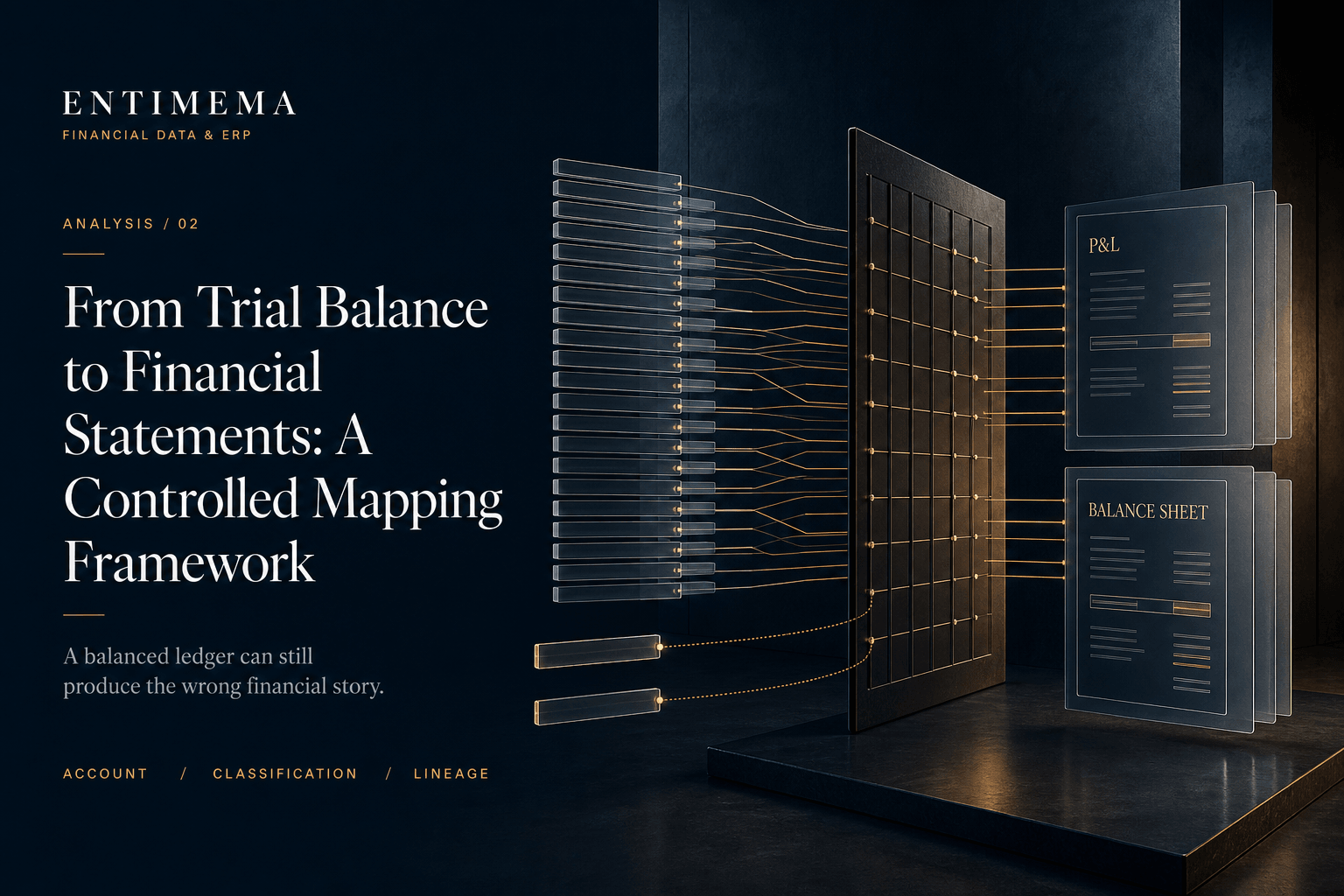
A balanced ledger can still produce the wrong financial story.
Reading the number is not the same as proving it.
The most dangerous error is the one the system presents without hesitation.

Set decision-specific latency budgets, trace event-to-action delay and modernise the paths where stale information changes risk, value or customer outcomes.

Resolve one economic borrower across identities, parties, facilities, exposures and behaviour—then reconstruct the governed customer state required at decision time.

Separate payment events from settlement, posting, accounting, delinquency and risk state—then reconcile each decision to the event history and finality it requires.

Trace the broken path from financial event to analytical state and executable decision—then modernise the critical path without defaulting to core replacement.

Convert promise events into measurable evidence using fulfilment amount, timing, credibility, cure conversion, re-default, incremental value and probability-weighted cash forecasts.

Distinguish technical cure from durable recovery using post-cure behaviour, survival, re-default risk, cure vintages, path dependence and economic loss evidence.

Rank delinquent accounts by changeable economic outcome—not risk alone—using exposure, natural cure, recoverability, contactability, treatment effect, cost and capacity.

Transform payment, utilisation, liquidity and delinquency histories into dynamic risk estimates, migration evidence and governed lifecycle decisions.
Convert noisy behavioural change into corroborated deterioration evidence, exposure-aware priority, proportional intervention and measurable portfolio learning.

Monitor configured logic and effective production behaviour across population, funnels, rules, offers, overrides, booking, outcomes and attribution.

Move from replay claims to governed evidence through decision migration, common-support assessment, sensitivity, controlled deployment, mature vintages and economic attribution.

Connect expected loss, funding, operating cost and capital with affordability, take-up and selection so price maximises sustainable risk-adjusted value—not nominal yield.

Move beyond approve or reject: combine borrower risk, affordability, utilisation, EAD, marginal value and portfolio capacity to set and reassess exposure.

Separate borrower risk from capacity, reconstruct sustainable cash flow, stress the proposed obligation and optimise amount, tenor and price inside one governed lending decision.

Move from rule inventory to rule architecture by testing every control for purpose, precedence, unique decision contribution, outcome evidence and complexity cost.

A credit decision engine is not a model endpoint. It is the orchestration layer where risk, affordability, policy, fraud, economics and operational constraints become one governed action.

Reconstruct historical allowance, align mature outcomes, validate PD, LGD, EAD, SICR and scenarios, reconcile the engine and convert model error into financial materiality.

Translate coherent economic paths into scenario-specific PD, LGD, EAD, staging and loss before weighting outcomes, testing sensitivity and governing judgement.

Connect contractual balances, utilisation, undrawn commitments, prepayment and default timing into an EAD term structure that can be challenged and backtested.

Convert post-default cash flows, costs, cure, collateral and recovery timing into scenario-sensitive economic loss that can be backtested by level and timing.

Convert conditional period risk through survival into marginal and cumulative default probabilities that preserve loss timing for lifetime ECL.

Reconstruct initial risk, measure comparable lifetime deterioration and combine quantitative, behavioural, qualitative and forward-looking evidence into explainable Stage 2 migration.

Connect credit state, lifetime PD, recoveries, exposure, scenarios and discounting into one coherent allowance and an explanation management can use.

Move from metric validation to an evidence architecture that establishes whether a model is fit for its intended decision.

A PD model can preserve borrower ordering while becoming materially wrong about absolute risk. Calibration drift is where useful ranking and wrong probabilities coexist.

PSI tells you that a population distribution changed. Whether that change affects risk, calibration or decisions requires a separate diagnosis.

A model probability is not yet an operational credit score. Scaling is the governed mathematical layer that turns odds into stable points, cut-offs and executable decisions.

Logistic regression remains powerful because it creates a disciplined bridge between borrower characteristics, odds of default, explainable ranking and production decisions.

WoE and IV impose structure on messy borrower data. They become dangerous when practitioners mistake that modeller-created structure for truth.

A credit scorecard is not regression with points attached. It is a governed architecture that turns imperfect borrower data into a stable, interpretable and operational lending signal.

Reject inference is not a licence to invent outcomes. It is a disciplined investigation of selective observation, empirical support and the assumptions required to learn beyond the historically accepted population.

A flagship framework for consumer lenders, fintechs and NBFIs to connect approvals, pricing, credit loss, acquisition, collections and portfolio feedback to sustainable risk-adjusted economic value.
The purpose is not to predict every default. It is to detect meaningful deterioration early enough for a different decision to still matter.

Default is the end of the story. Roll rates reveal how deterioration, persistence and cure develop inside a portfolio while action is still possible.

There is no statistically optimal cut-off in isolation. The boundary is where marginal economics, risk appetite, approval volume and uncertainty meet.

A PD model does not discover default independently. It learns the definition of default embedded in its target—and carries that boundary into every probability and decision.

A compact diagnostic framework for matching model intervention to calibration failure, ranking deterioration, population change and structural instability.

A diagnostic architecture for separating data, population, ranking, calibration, outcome and decision-system change before selecting a model response.

A model can rank risk remarkably well and still support the wrong lending decision.

A borrower can remain in exactly the same relative risk position while the probability attached to that position changes materially.

Manufacturing cost becomes decision-useful when accounting values are connected to production stages, economic drivers and management decisions.

Receivables, inventory and payables reveal their cash and financing consequences only when KPI movements are traced through operating drivers, process owners and responsible actions.

Tracing operating drivers, constraints and financial relationships through the P&L, balance sheet and cash flow turns a coherent projection into a model management can interrogate.

Aligning origination cohorts by credit age exposes vintage divergence early, while segmentation and validation determine whether the signal warrants a credit-policy response.

Reconciliation and consistent business semantics connect technical transactions to analytical models, giving management evidence it can use without confusing system accuracy with decision completeness.
Explore how AI agents can support financial analysis, risk assessment and decision workflows.