Our commitment to security
Financial intelligence requires disciplined data handling.
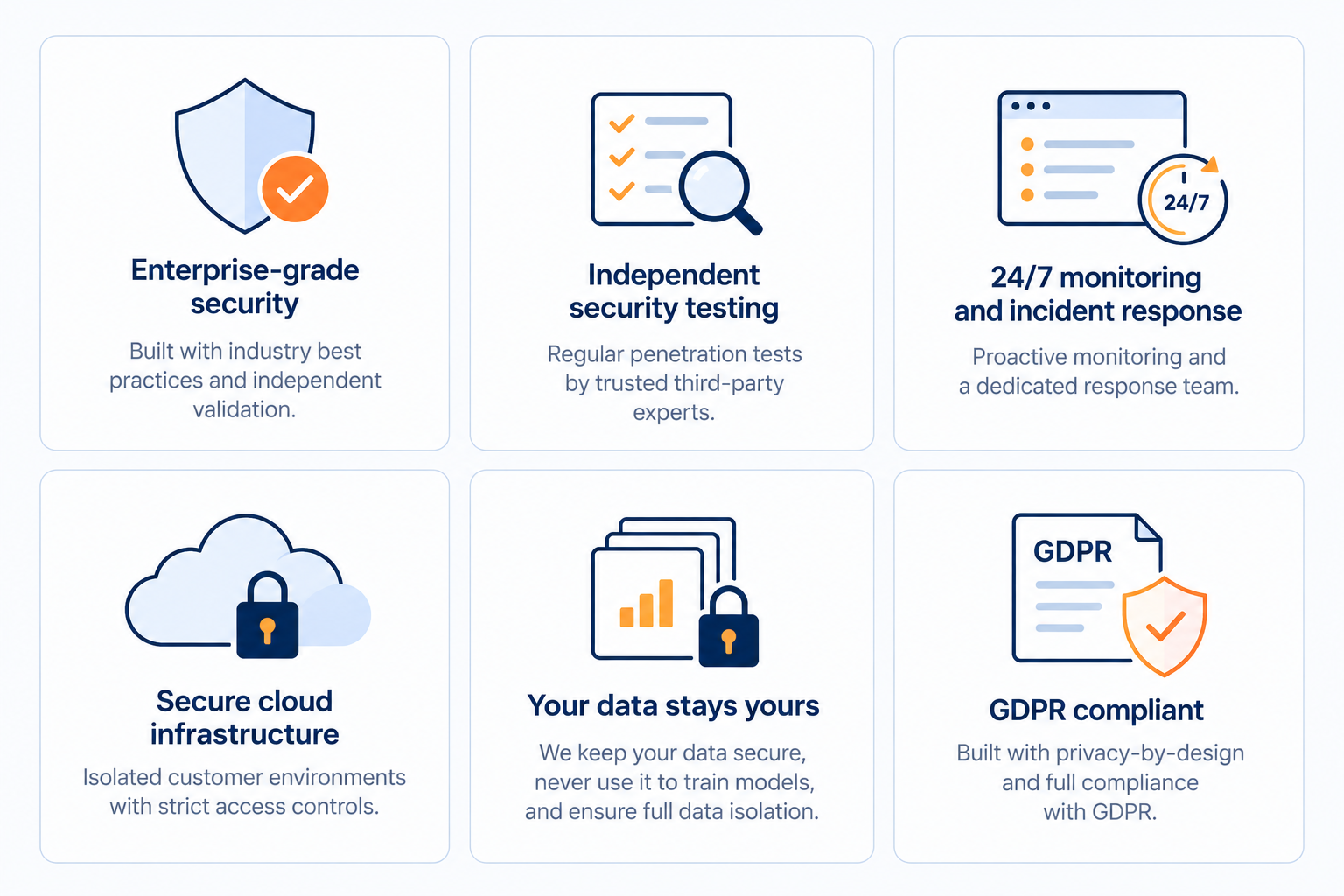
Entimema combines controlled access, purpose-limited processing, source traceability and human review around financial workflows. Each production capability is assessed against its actual data, infrastructure and deployment scope.
Control baseline
Purpose-limited processing: Data is processed for the requested workflow and assessed against the capability’s defined purpose.
Controlled access: Access expectations are defined around authenticated workspaces, authorised contexts and operational need.
Source-grounded outputs: Source-value lineage keeps supported outputs connected to the financial evidence used to produce them.
Human accountability: Exceptions and material judgement remain visible so an authorised person can review the result.
Current verified Financial Intelligence V1 scope
The present assurance boundary is specific to the controlled pilot. It reflects the tested workflow rather than a platform-wide promise.
- Tested English XLSX and text-based PDF Income Statements
- Authenticated Financial Intelligence workspace
- Secure file-byte validation and request-scoped processing
- Source-value lineage
- Supported deterministic financial checks and KPIs
- Explicit exceptions and human review
Explicit scope boundary
The current scope does not claim support for scanned or OCR PDFs, whole annual-report discovery, non-English statements, arbitrary financial-statement types, or every workbook and PDF layout.
Data and AI
Workflow-purpose limitation: Customer documents and financial data are processed for the requested workflow.
Provider review: Provider roles, access and data-handling behaviour are considered for the production capability in which they are used.
Customer-context separation: Customer documents are not used to train shared Entimema models.
Minimal diagnostics: Operational diagnostics should be privacy-safe and limited to what is needed to support, secure and understand the workflow.
Infrastructure and data protection
Protected transport: Production capabilities are designed to transmit customer data through protected application and provider channels appropriate to the deployed workflow.
Customer-context isolation: Financial data is associated with its authorised customer and workflow context; access boundaries are assessed as part of each production capability.
Storage and retention: Storage, retention and deletion behaviour is defined against the actual infrastructure used by the capability rather than assumed at platform level.
Application and operational security
Controlled development: Production changes pass controlled source, validation and deployment processes before release.
Security-aware diagnostics: Operational failures and relevant events are handled with diagnostics designed to support investigation without unnecessarily exposing customer financial data.
Least-necessary access: Administrative and operational access is limited to legitimate support, review and security needs within the deployed capability.
Incident, recovery and deletion readiness
Incident handling: Security and data-handling issues are assessed against the affected workflow, information, provider and access context so containment and remediation can be targeted to the actual exposure.
Recovery: Recovery requirements are defined in relation to the information and services that a production capability actually stores or depends on.
Deletion: Retention and deletion expectations are mapped to the workflow and customer engagement, including relevant provider responsibilities.
Output governance
Ready: Supported processing and checks completed without a surfaced review condition.
Review required: An exception, ambiguity or unsupported condition needs human attention before use.
Blocked: The workflow cannot produce a dependable result within its defined boundary.
Security review
A security discussion can map the proposed workflow to the data received, processing purpose, provider roles, access expectations, retention approach, deletion process and human-review responsibilities.