Founder, Entimema

Alexander Dimitrov

His work sits across finance, accounting and controlling, credit risk, financial systems and decision architecture.

Alexander Dimitrov, Founder of Entimema

Alexander Dimitrov’s experience spans financial management, SAP and ERP environments, credit risk, quantitative analysis and automation.

At Entimema, he leads the development of financial methodologies, decision workflows, practitioner research and AI-assisted products.


01 / Practitioner foundations

Different disciplines.
One decision.

Finance, accounting, risk and systems offer different perspectives on the same problem: how financial information becomes an understandable, controlled and actionable decision.

  1. Finance

    Planning, reporting, cost and margin architecture connect measurement to management choices. The question is what a number allows someone to understand and decide.

  2. Accounting & controlling

    Accounting and controlling provide the financial basis for those choices. Reconciliation and consistent financial logic make that basis explainable and open to review.

  3. Credit risk & decision science

    Credit-risk methodology and quantitative analysis bring uncertainty and decision boundaries into view. Model governance keeps interpretation connected to the responsibilities of the decision.

  4. Systems & decision workflows

    SAP, ERP and financial data structures connect the model to its operating environment. Controlled workflows carry evidence, interpretation and human review into repeatable use.

02 / The recurring problem

The missing layer is decision structure.

That combination of disciplines brings a recurring problem into view. Organisations can possess data, models, reports and systems without reliably producing decisions that people can understand, control and improve.

Data
Availability does not ensure understanding.
Models
An analytical result is not yet a decision.
Reports
Information does not determine what happens next.
Automation
Execution does not, by itself, establish control.

03 / A practical point of view

A model has to work in practice.

The best model is not the most complex one. It is the one that can operate inside a real organisation—across its data, systems, constraints and decision responsibilities.

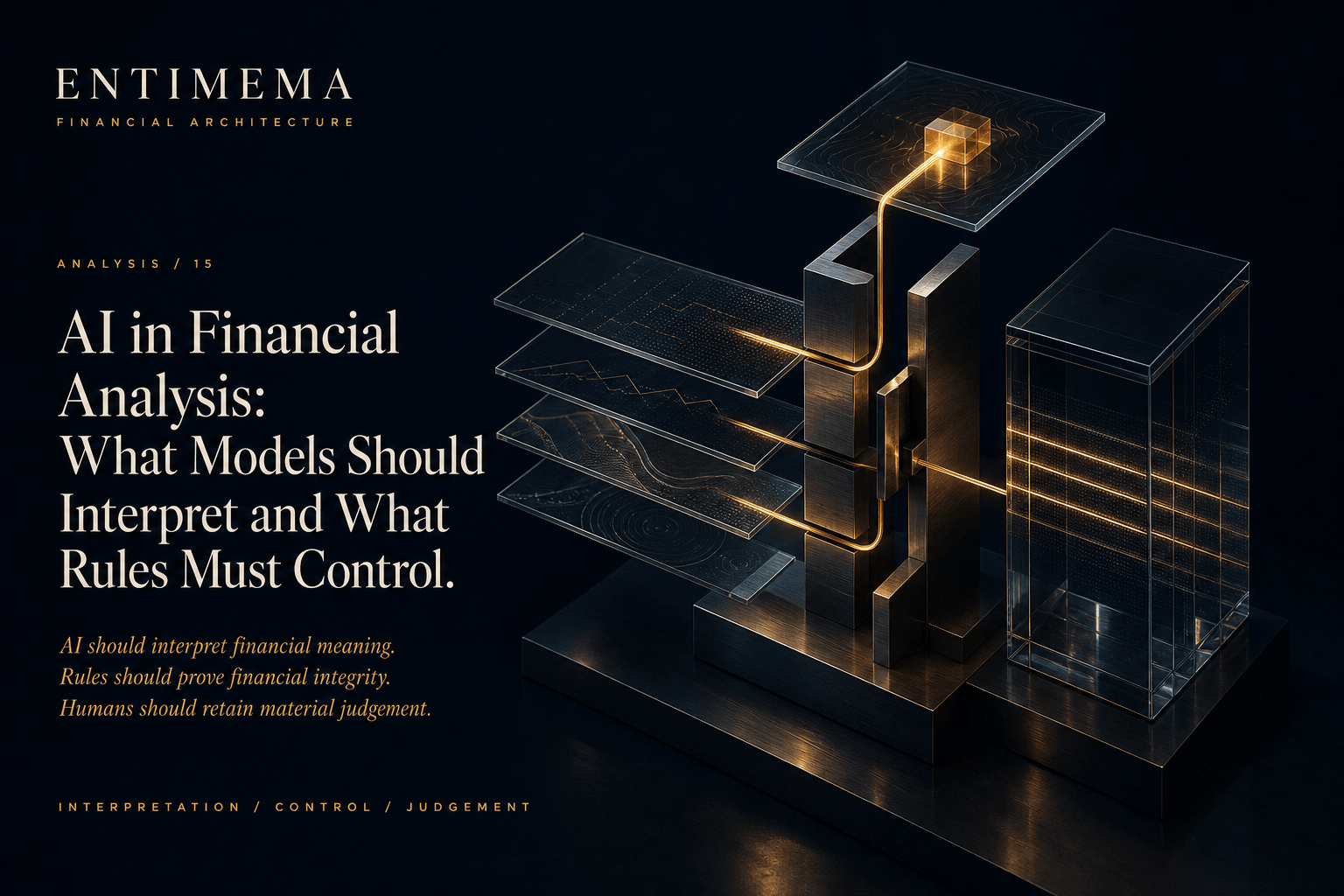
Model interpretation gives financial information meaning. Deterministic controls test the calculations and constraints on which a decision depends.

Human judgement remains responsible for the conclusion. Traceability makes the path open to review; practical usability makes it possible to work with the result.

04 / Why Entimema

From practitioner questions to institutional work.

The practitioner question becomes an institutional one: how can financial decisions be made understandable, traceable and useful inside the organisation?

Entimema gives that question a programme of work: financial methodologies, decision workflows, practitioner research and AI-assisted products. Specialist knowledge becomes a system that can be used, examined and improved.

Why Entimema

05 / Research as evidence

The questions behind the work.

These six publications examine the questions behind financial interpretation, risk and control. They make the reasoning available for scrutiny, from the source of a number to the workflow in which it is used.

Explore all research

06 / From reasoning to use

The work continues in the workflow.

The same concerns—financial data, reconciliation, evidence lineage, model interpretation, deterministic controls and human review—come together in Financial Intelligence as operational financial workflows.